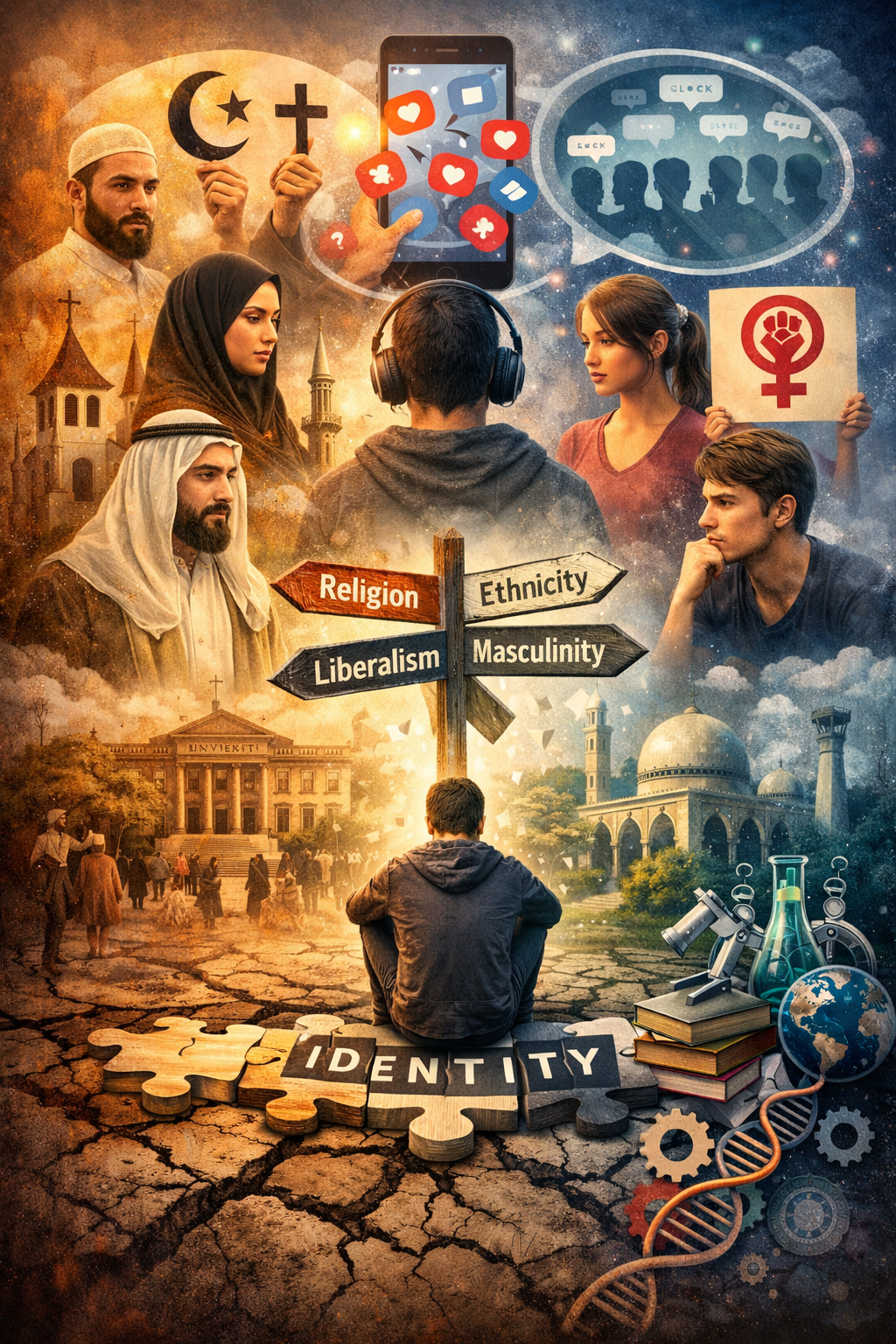
Identity and Its Struggle in the Age of Social Media and Belief Systems
-
 Shams Khan
- 6 Min To Read
- 30 Mar, 2026
Lately, I have been observing that people are doing whatever they can to hold on to an identity or carve out a unique, distinctive identity for themselves. They go to great lengths to define and distinguish who they are.
Naturally, the younger you are, the more inclined you are to shape your identity. The most common routes are religion and ethnicity. Religion gives identity. Ethnicity gives identity. Other pursuits in life can also shape identity.
Increasingly, I see young people identifying themselves through religion. In today’s age—with scientific breakthroughs, easy access to knowledge, and rapid innovation—this feels somewhat unusual. There is nothing wrong with believing in a religion. However, defining yourself entirely as an embodiment or representative of a religion is a different matter. When religion becomes your sole identity, it moves to another level.
To me, religion is just one facet of life. It is about beliefs—beliefs that may not always align with rational inquiry. You accept them as they are. But turning religion into your entire identity seems excessive. That role, one might think, belongs more to spiritual leaders—priests, imams, bishops, gurus—rather than everyday individuals.
Yet today, we see this phenomenon widely. In my own interactions, mostly with people of the Islamic faith, I notice many young individuals defining themselves through religion. Some grow beards, wear traditional Arab clothing, or adopt visible religious symbols. Women may wear the hijab. This raises an important question: what is driving this strong identification?
When I was in university in the United States 30 years ago, I did not feel the need to define myself by religion or ethnicity. I was an international student, but that was just one aspect of my identity. I wanted to integrate, adopt the positive aspects of society, and blend in. Today, the situation seems quite different. Many young people appear to live in bubbles.
These bubbles exist both physically and online. Social media feeds, friend circles, and algorithms create echo chambers that constantly reinforce specific ideologies. Over time, these beliefs become stronger and are reflected in daily life.
I believe a major difference between then and now is social media. We did not have these platforms, these echo chambers, or the constant validation they provide. It was harder to build an identity purely on ideas without real-world grounding. Today, identities are often formed online first and then carried into real life.
This trend is not limited to religion. Some people define themselves through liberal ideologies, feminism, or alternative views on masculinity and gender roles. Across the spectrum, individuals are carving identities based on various causes.
However, social media appears to amplify all of this. Without it, the intensity of such identity formation might have been much lower. Of course, one could argue whether this is causation or merely correlation.
Another possible factor is the influence of educational environments, many of which lean toward certain ideological perspectives. This may also shape how young people form their identities.
But fundamentally, I question the idea of building one’s identity entirely on ideologies that are centuries old—whether 1,400 years in the case of Islam or 2,000 years in the case of Christianity. While these traditions have value, relying on them as the primary foundation of identity feels limiting in today’s world.
We all want to be unique. We want recognition, respect, and a sense of belonging. Sometimes, we adopt identities that help us achieve these goals—whether it is gaining approval from society, attracting opportunities, or even pleasing our families.
In many cases, our identity is shaped by our upbringing. We internalize the beliefs of our parents, teachers, and environment. Often, we adopt these beliefs not just out of conviction but also to gain approval and make our loved ones proud.
Embracing these beliefs is one thing, but turning them into our entire identity is another. It can become a way of seeking validation.
Recently, I attended a fundraising event for the homeless on a university campus. One would expect such an event to be secular, yet it was deeply religious in structure—from recitations to prayer breaks to religious closing remarks. Even the keynote speaker’s appearance strongly reflected religious identity. This made me reflect on the direction in which future leaders might be heading.
In conclusion, we all crave comfort, identity, and belonging. We are vulnerable to influences that validate us and make us feel accepted. Often, we choose the path of least resistance—the one that earns approval and avoids criticism.
Religion-based identity is just one form of this broader phenomenon.
However, I believe we can do better.
We can hold our beliefs dearly without making them our entire identity. Our identity can instead be built on something greater—seeking knowledge, creating, innovating, solving problems, and contributing to humanity.
We can start by improving ourselves, then helping our families, our communities, and eventually the world. There are no limits to what we can achieve if we focus on growth, wisdom, and meaningful contribution.
Defining ourselves solely through inherited ideologies may restrict us. But defining ourselves through knowledge, rational thinking, and action can expand our potential.
I say this with humility. Like anyone else, I have my own shortcomings. But through learning, reflection, and effort, I hope to overcome some of them and contribute—however modestly—to making the world a better place.