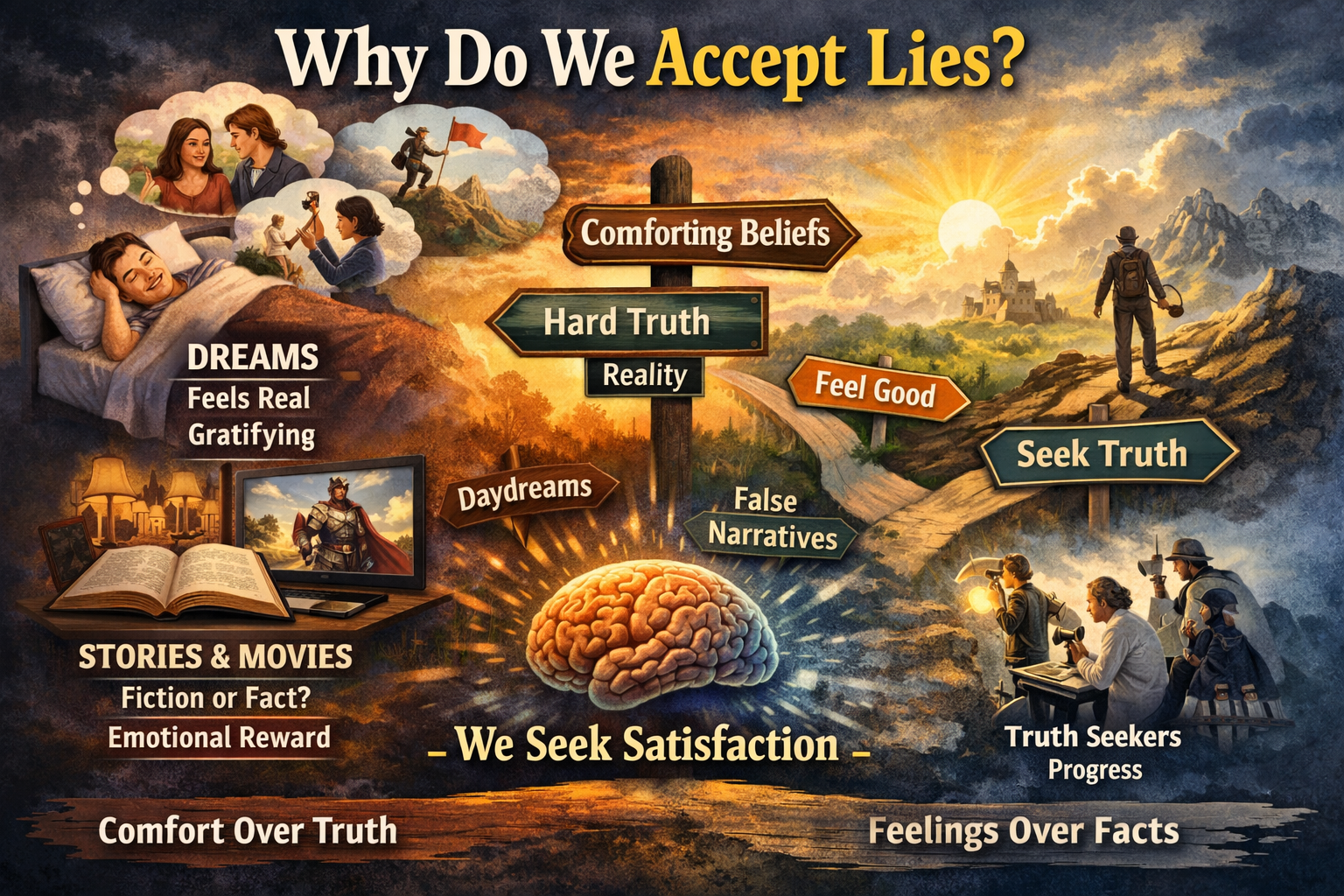
Why Do We Accept Lies?
-
 Shams Khan
- 6 Min To Read
- 03 Apr, 2026
This morning, when I woke up, I lingered in bed and did not get up at my usual time. Instead of waking at 5 a.m., I stayed in bed until almost 8 a.m. During those extra three hours, I drifted in and out of sleep and had many dreams.
Some of those dreams I remember clearly because I was in a semi-conscious state. I was aware of them as they were happening, and even after waking up, I could still recall them. Most of these dreams involved my past, people I know, and sometimes new scenarios and situations. I would interact with familiar faces or imagine entirely new experiences.
This led me to think about something interesting. My mind does not truly distinguish between reality and dreams. It treats both as real experiences and gives me a sense of satisfaction from them. Otherwise, why would I feel anything at all from a dream?
Even though those events never actually happened, they still provide gratification. So, to the mind, it does not matter whether something is real or not. If it produces a feeling, it is good enough.
Then I thought further. If we remembered all our dreams clearly, it would create confusion. We would not be able to distinguish what actually happened from what we only dreamed. So, there seems to be an elegant solution built into us. Upon waking, we forget most of our dreams. Even if we remember them, it is only for a short time before they fade away. This seems like a clever way to allow us to experience dreams without mixing them up with reality.
From there, I extended this idea further.
When we read a book, whether it is fiction or non-fiction, we derive satisfaction from it. Even when we know something is fictional, we still enjoy it. We do not reject it simply because it is not real. We accept it for the feelings and experience it provides.
The same applies when we watch movies. Whether a story is true or entirely fictional does not matter much to us. What we seek is the emotional experience, the excitement, and the reward it gives us. The truth behind it becomes secondary.
This made me question our beliefs as well.
Do we truly examine whether our beliefs are valid? Do we check if they align with reality or follow the laws of nature? Or are we more interested in the comfort, reassurance, or reward they provide?
Often, we accept beliefs not because they are true, but because they make us feel better. If something promises reward, hope, or meaning, we are inclined to accept it—even if it may not be realistic. We are wired to seek benefit, not necessarily truth.
In that sense, we are driven by what satisfies us. If something calms us, gives us hope, or fulfills a need, we accept it. If it did not serve us in some way, we would likely reject it.
This also connects to how our mind operates by default. Our brain often drifts into rumination and daydreaming. These states are rarely grounded in reality. We imagine scenarios that may never happen. We solve problems, achieve great things, or live out ideal versions of life—all within our minds.
Our brain is not naturally designed to seek truth — it is designed to seek reward. It does not strongly distinguish between what is real and what is imagined. What matters is the feeling and the payoff, not whether the experience is actually true.
From a psychological perspective, the brain rewards experiences regardless of reality. Even imagination activates similar brain regions as real actions. Studies have shown that when golfers mentally rehearse their shots, the same areas of the brain are activated as when they physically hit the ball. This tells us something fundamental: the brain responds to experience, not just reality.
Because of this, humans operate on a balance between truth and emotional reward. In practical areas like science, survival, and business, we tend to seek truth. But in emotional and existential areas, we often prefer comfort. This is driven by cognitive biases and reward-based thinking, where the brain prioritizes what feels good over what is accurate.
Our default mental state reinforces this. The brain naturally drifts into imagination, storytelling, and daydreaming — what psychologists call the default mode network. These are not grounded in reality, yet they shape how we think and feel. As a result, we live through narratives more than facts, often remembering stories while overlooking reality.
Again, we are not seeking truth in these moments. We are seeking the reward those thoughts provide.
This realization led me to an important conclusion.
Perhaps truth-seeking is not our natural default. What we naturally pursue is feeling good—seeking gratification, comfort, and emotional reward. Truth, on the other hand, can be difficult, uncomfortable, and sometimes unrewarding in the short term.
So, we often compromise truth for the sake of feeling good.
On one end of the spectrum is truth. On the other is emotional satisfaction. Most of us lean toward feeling good rather than seeking truth.
Of course, there are exceptions. Some individuals dedicate their lives to seeking truth, even when it goes against popular beliefs or narratives. These are the people who drive progress, make discoveries, and challenge the status quo. Society needs such individuals.
But for the majority of people, it is unrealistic to expect constant truth-seeking. Most of us operate based on what feels right rather than what is objectively true.
Recognizing this mechanism is important. It allows us to become more aware of our own tendencies.
I hope we can all learn to see reality more clearly and not ignore it simply for the sake of comfort or emotion.
God bless us all.